
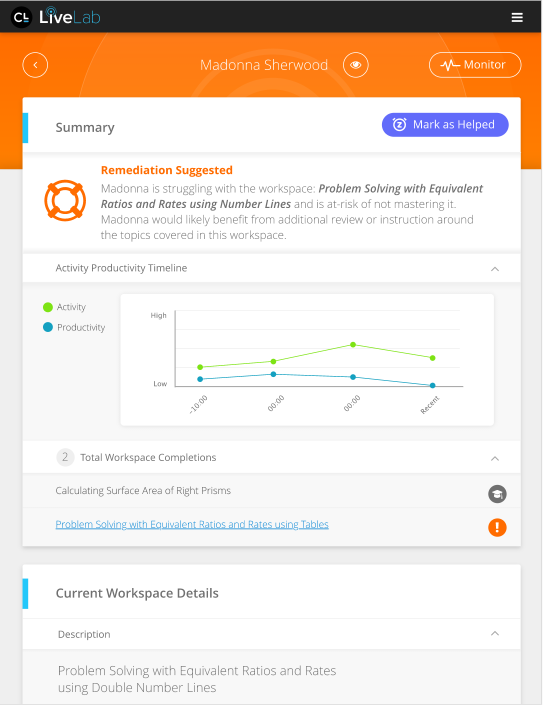
Classroom orchestration tools allow teachers to identify student needs and provide timely support. These tools provide real-time learning analytics, but teachers must decide how to respond under time constraints and competing demands. This study examines the relationship between indicators of student states (e.g., idle, struggle, system misuse) and teachers' decisions about whom to help, using data from 15 classrooms over an entire school year (including 1.6 million student actions). We found that teachers primarily helped students based on idleness, while student help seeking in the tutoring system was primarily related to struggle. Furthermore, our findings show that students' receipt of help from teachers was significantly positively correlated with their in-system learning rate.
Who to Help? A Time-Slice Analysis of K-12 Teachers' Decisions in Classes with AI-Supported Tutoring
Abstract
Summary
When K-12 classrooms use AI tutoring software, teachers still play a crucial role -- but how do they decide which student to walk over to? Analyzing 1.6 million student actions across a full school year, this study finds that teachers tend to prioritize idle students over struggling ones, and that receiving teacher help is linked to faster learning, highlighting the importance of smart dashboard design that guides teacher attention effectively.