
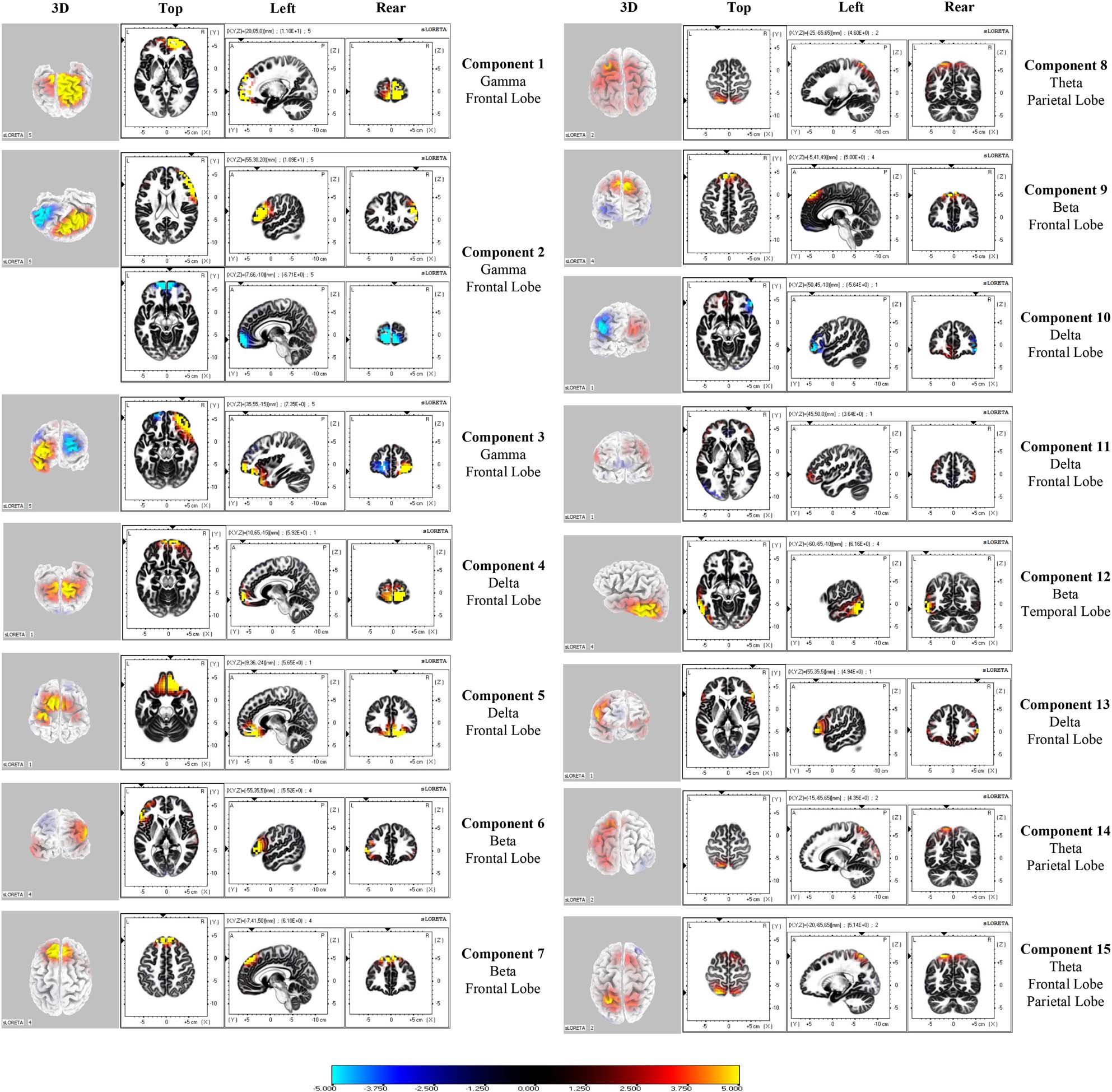
Emotions significantly shape the way humans make decisions. However, the underlying neural mechanisms of this influence remain elusive. In this study, we designed an experiment to investigate how emotions (specifically happiness, fear, and sadness) impact spatial decision-making, utilizing EEG data. To address the inherent limitations of sensor-level investigations previously conducted, we employed standard low-resolution brain electromagnetic tomography and functional independent component analysis to analyze the EEG data at the cortical source level. Our findings showed that across various spectral-spatial networks, positive emotion activated the decision-making network in the left middle temporal gyrus and inferior temporal gyrus, in contrast to negative emotions. We also identified the common spectral-spatial networks and observed significant differences in network strength across emotions.
Differential Effects of Specific Emotions on Spatial Decision-Making: Evidence from Cross-Frequency Functionally Independent Brain Networks
Abstract
Summary
This neuroscience study uses brain imaging (EEG) to uncover how different emotions like happiness, fear, and sadness change the way our brains handle spatial decisions, pinpointing distinct brain network patterns for positive versus negative feelings. The findings advance our understanding of the brain circuitry linking emotion and decision-making, with implications for designing systems that account for users' emotional states.